


 Loading…
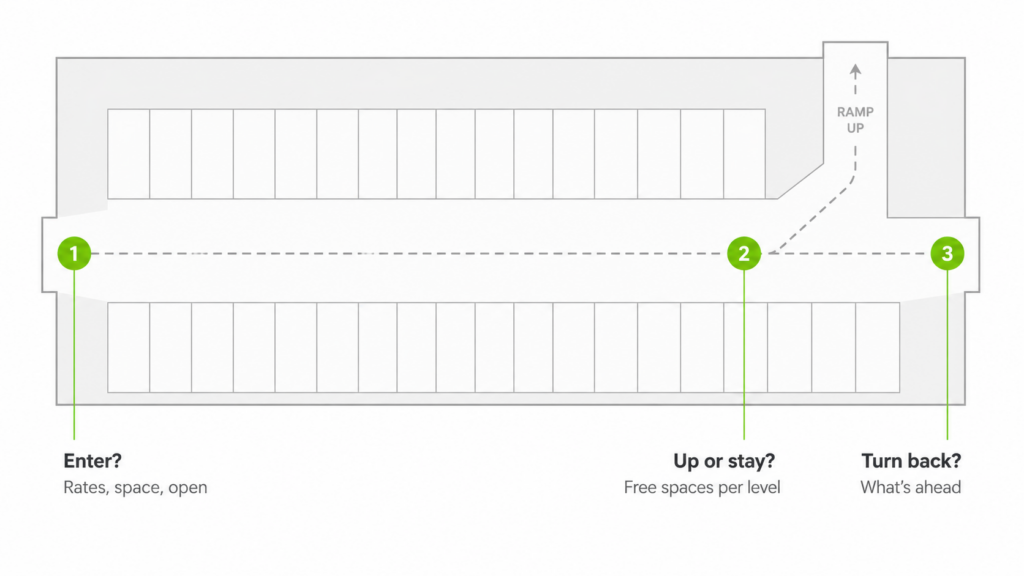
Three points inside a garage, and what belongs at each one.
Most circling isn’t a layout problem. It’s a timing problem: the driver gets the information after the moment they needed it.
And there are fewer of those moments than people assume. Between the street and the parking space, a driver makes three real decisions. Everything else is just driving.
Here’s what happens at each one, and what belongs there.
1. At the street: come in, or keep going?
The decision: whether this facility is worth entering at all.
What the driver needs: the rate, whether there’s space, and whether you’re open. In that order, because price is what makes them consider you and availability is what makes them commit.
Where it belongs: visible from the road, far enough ahead that they can still change lanes. The rule of thumb is simple: a driver at 20 mph covers about 30 feet per second. If your rates only become readable at the entrance itself, the decision was already made, and it wasn’t yours.
This is the point where most facilities lose customers without ever knowing it. Nobody complains about a garage they didn’t enter.
2. At the ramp split: up, or stay?
The decision: which level to try.
What the driver needs: free spaces per level. Not “the garage is 80% full”, which tells them nothing actionable. The number that matters is how many spaces are waiting two floors up.
Where it belongs: before the split, never after. A display placed past the branching point is a display the driver reads while already committed to the wrong ramp.
Keep it to one number per level. A driver reading this is moving, mid-turn, and often mid-conversation. Anything beyond a level name and a count won’t be read.
3. At the end of an aisle: keep going, or turn back?
The decision: whether there’s anything worth finding further ahead.
What the driver needs: what’s beyond this point. Spaces further down, another ramp, an exit, nothing at all.
Where it belongs: at the end of the aisle, facing the driver. This is the most commonly skipped point of the three, and it’s the one that generates the most wasted laps. A driver who reaches a dead end with no information does the only thing available: turns around and tries somewhere they’ve already been.
Three points, not thirty
The instinct, once you start thinking about this, is to add screens. It’s usually the wrong instinct.
A facility with one well-placed display at the street and accurate level counts at each ramp will outperform a facility with six screens scattered wherever there was a convenient wall. Placement beats quantity, every time, because a screen the driver reads too late is functionally the same as no screen at all.
The exercise worth doing: drive your own facility as a first-time visitor. At each of these three points, ask what you actually know. Every blank is a driver circling.